



Appearance
Appearance
The Tcpdump tool and its libpcap library are written in C and C++ and were released for Unix-like systems in the late 1980s or early 1990s. Consequently, they are very stable and offer optimal speed. The libpcap library is the foundation for various other networking tools today. Moreover, it was ported to MS Windows as winpcap.
You can run tcpdump without providing any arguments; however, this is only useful to test that you have it installed! In any real scenario, we must be specific about what to listen to, where to write, and how to display the packets.
| Command | Explanation |
|---|---|
tcpdump -i INTERFACE | Captures packets on a specific network interface |
tcpdump -w FILE | Writes captured packets to a file |
tcpdump -r FILE | Reads captured packets from a file |
tcpdump -c COUNT | Captures a specific number of packets |
tcpdump -n | Don't resolve IP addresses, i.e. not display hostname |
tcpdump -nn | Don't resolve IP addresses and don't resolve protocol numbers |
tcpdump -v | Verbose display; verbosity can be increased with -vv and -vvv |
Consider the following examples:
tcpdump -i eth0 -c 50 -v captures and displays 50 packets by listening on the eth0 interface, which is a wired Ethernet, and displays them verbosely.tcpdump -i wlo1 -w data.pcap captures packets by listening on the wlo1 interface (the WiFi interface) and writes the packets to data.pcap. It will continue till the user interrupts the capture by pressing CTRL-C.tcpdump -i any -nn captures packets on all interfaces and displays them on screen without domain name or protocol resolution.Logical Operators Three logical operators that can be handy:
and: Captures packets where both conditions are true. For example, tcpdump host 1.1.1.1 and tcp captures tcp traffic with host 1.1.1.1.or: Captures packets when either one of the conditions is true. For instance, tcpdump udp or icmp captures UDP or ICMP traffic.not: Captures packets when the condition is not true. For example, tcpdump not tcp captures all packets except TCP segments; we expect to find UDP, ICMP, and ARP packets among the results.| Command | Explanation |
|---|---|
tcpdump host IP 或 tcpdump host HOSTNAME | Filters packets by IP address or hostname |
tcpdump src host IP 或 | Filters packets by a specific source host |
tcpdump dst host IP | Filters packets by a specific destination host |
tcpdump port PORT_NUMBER | Filters packets by port number |
tcpdump src port PORT_NUMBER | Filters packets by the specified source port number |
tcpdump dst port PORT_NUMBER | Filters packets by the specified destination port number |
tcpdump PROTOCOL | Filters packets by protocol; examples include ip, ip6, udp, tcp, and icmp |
Consider the following examples:
tcpdump -i any tcp port 22 listens on all interfaces and captures tcp packets to or from port 22, i.e., SSH traffic.tcpdump -i wlo1 udp port 123 listens on the WiFi network card and filters udp traffic to port 123, the Network Time Protocol (NTP).tcpdump -i eth0 host example.com and tcp port 443 -w https.pcap will listen on eth0, the wired Ethernet interface and filter traffic exchanged with example.com that uses tcp and port 443. In other words, this command is filtering HTTPS traffic related to example.com.you can count the lines by piping the output via the wc command
user@TryHackMe$ tcpdump -r traffic.pcap src host 192.168.124.1 -n | wc
reading from file traffic.pcap, link-type EN10MB (Ethernet)
910 17415 140616补充
# What is the IP address of the host that asked for the MAC address of 192.168.124.137?
tcpdump -r traffic.pcap arp端口 53 是 DNS(域名系统) 使用的端口。DNS 负责将人类可读的域名(例如 example.com)转换为计算机可理解的 IP 地址(例如 192.168.1.1),使设备能够正确找到目标服务器。
DNS 主要使用两种协议:
# What hostname (subdomain) appears in the first DNS query?
tcpdump -r traffic.pcap port 53 -nHeader Bytes
The purpose of this section is to be able to filter packets based on the contents of a header byte. Consider the following protocols: ARP, Ethernet, ICMP, IP, TCP, and UDP. These are just a few networking protocols we have studied. How can we tell Tcpdump to filter packets based on the contents of protocol header bytes? (We will not go into details about the headers of each protocol as this is beyond the scope of this room; instead, we will focus on TCP flags.)
Using pcap-filter, Tcpdump allows you to refer to the contents of any byte in the header using the following syntax proto[expr:size], where:
proto refers to the protocol. For example, arp, ether, icmp, ip, ip6, tcp, and udp refer to ARP, Ethernet, ICMP, IPv4, IPv6, TCP, and UDP respectively.
expr indicates the byte offset, where 0 refers to the first byte.
size indicates the number of bytes that interest us, which can be one, two, or four. It is optional and is one by default. To better understand this, consider the following two examples from the pcap-filter manual page (and don’t worry if you find them difficult):
ether[0] & 1 != 0 takes the first byte in the Ethernet header and the decimal number 1 (i.e., 0000 0001 in binary) and applies the & (the And binary operation). It will return true if the result is not equal to the number 0 (i.e., 0000 0000). The purpose of this filter is to show packets sent to a multicast address. A multicast Ethernet address is a particular address that identifies a group of devices intended to receive the same data.
ip[0] & 0xf != 5 takes the first byte in the IP header and compares it with the hexadecimal number F (i.e., 0000 1111 in binary). It will return true if the result is not equal to the (decimal) number 5 (i.e., 0000 0101 in binary). The purpose of this filter is to catch all IP packets with options.
Don’t worry if you find the above two examples complex. We included them so you know what you can achieve with this; however, fully understanding the above examples is not necessary to finish this task. Instead, we will focus on filtering TCP packets based on the set TCP flags.
You can use tcp[tcpflags] to refer to the TCP flags field. The following TCP flags are available to compare with:
tcp-syn TCP SYN (Synchronize)tcp-ack TCP ACK (Acknowledge)tcp-fin TCP FIN (Finish)tcp-rst TCP RST (Reset)tcp-push TCP PushBased on the above, we can write:
tcpdump "tcp[tcpflags] == tcp-syn" to capture TCP packets with only the SYN (Synchronize) flag set, while all the other flags are unset.tcpdump "tcp[tcpflags] & tcp-syn != 0" to capture TCP packets with at least the SYN (Synchronize) flag set.tcpdump "tcp[tcpflags] & (tcp-syn|tcp-ack) != 0" to capture TCP packets with at least the SYN (Synchronize) or ACK (Acknowledge) flags set.Tcpdump is a rich program with many options to customize how the packets are printed and displayed. We have selected to cover the following five options:
| Command | Explanation |
|---|---|
tcpdump -q | Quick and quite: brief packet information |
tcpdump -e | Include MAC addresses |
tcpdump -A | Print packets as ASCII encoding |
tcpdump -xx | Display packets in hexadecimal format |
tcpdump -X | Show packets in both hexadecimal and ASCII |
BPF:Expression 表达式
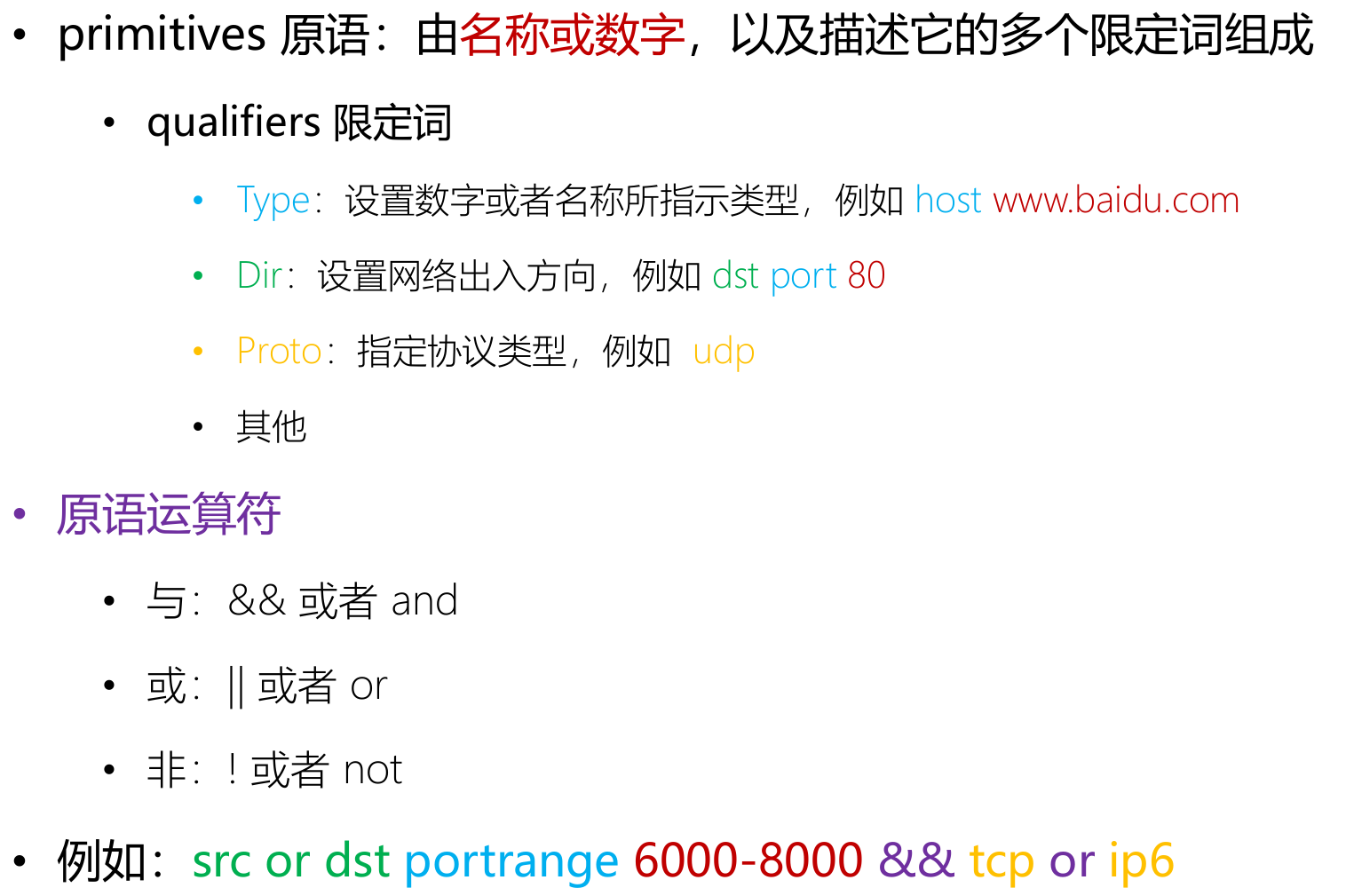
限定词
strftime 参数指定文件名